
- Home
- Projects
- Get the lead out: National push to identify service lines, protect drinking water
- Frequently Asked Questions - Lead Service Line Project
Frequently Asked Questions - Lead Service Line Project
What are the current regulations on lead regarding drinking water?
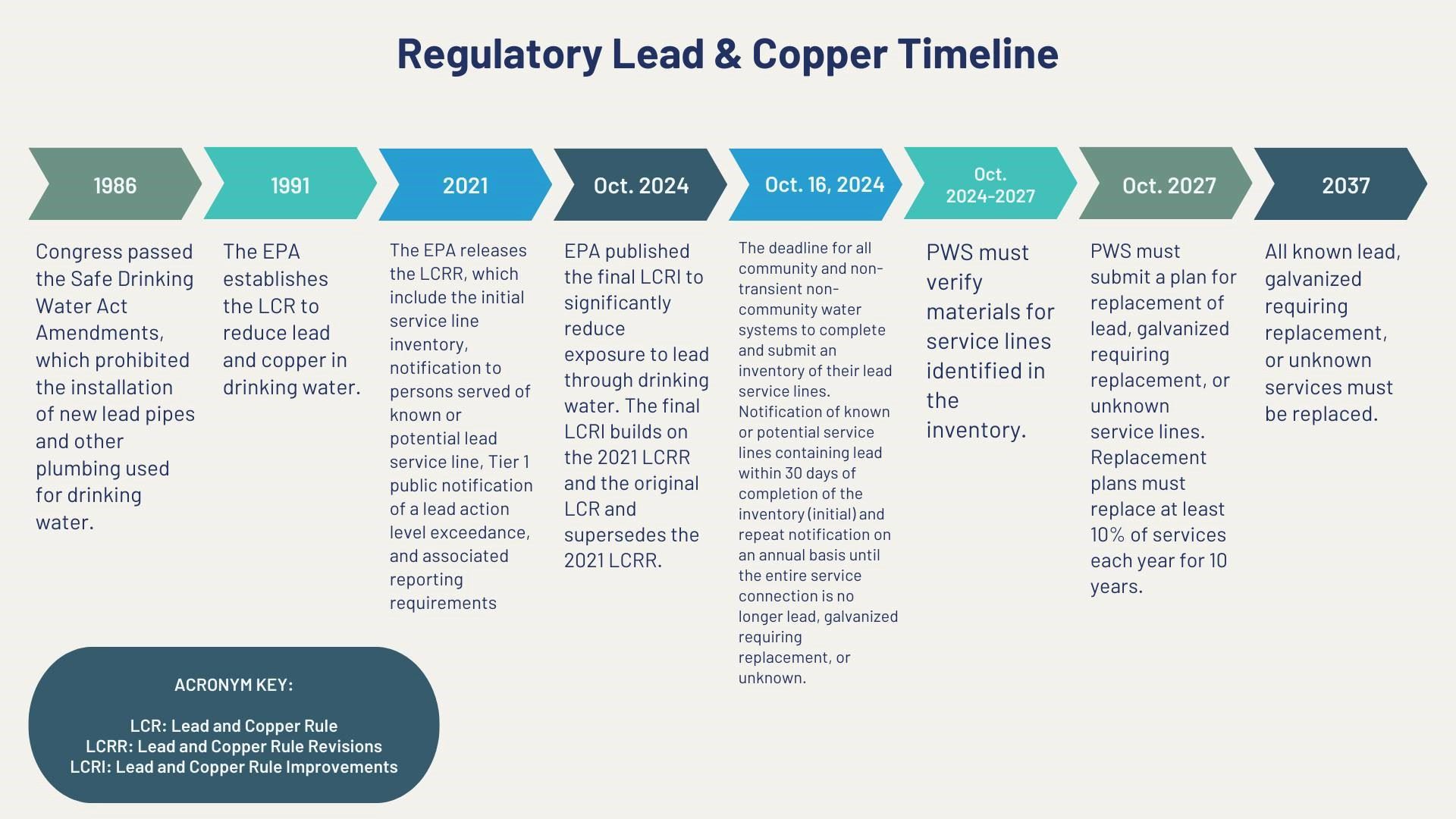
The Environmental Protections Agency (EPA) recognizes the danger lead poses in drinking water. In 1991, the EPA issued the Lead & Copper Rule mandating water systems adjust their water chemistry to control corrosion to limit lead leaching into the water. As of October 2024, revisions and additional requirements were added. The most recent revisions to the Lead and Copper Rule are available on the EPA LCRI website.
Why is TriRiver Water conducting an inventory of water service lines now?
The Town of Pittsboro and the City of Sanford have met all the required water quality regulatory standards and provided customers with high-quality water and services. It is important to recognize that lead is NOT in municipality drinking water when it leaves the distribution system or when the water travels through the municipality's water mains. However, homes or businesses across the country constructed before 1988 could have lead in the line connecting the home or business to the water meter (known as the service line) or in the home plumbing such as valves, fittings, and/or faucets.
Based on the EPA's revised Lead & Copper Rule mandating that all U.S. water utilities create inventories of their water service lines and connections, TriRiver Water is undertaking this multi-year project.
 What steps is TriRiver Water taking on this project?
- Step One of the process was an analysis of historic records of water service lines constructed before 1986 to determine the number and location of potential lead lines, galvanized required replacement (GRR) lines, and unknown composition service lines. We completed the initial analysis and submitted required information to the North Carolina Department of Environmental Quality (NCDEQ) on October 15, 2024.
- Step Two of the process is for us to visit each property between October 2024 and November 2027 and make a final determination of the material composition of each service line. After step two is complete, a replacement program will be developed.
- Lead and Copper Rule improvements issued by the federal government on October 8, 2024 require utilities nationwide to implement many new measures related to replacement of lead lines and lead sampling.
What does the visit to each property entail?
A property visit is simply a crew member visually inspecting the material of the water service line that is coming into your home. In some instances, the inspector may need to perform the "scratch test" on a metal pipe, but this will not damage the pipe. After the inspector finds and records the material of the water service line, they will leave the property.
What is a water service line and who owns it?
A water service line is the pipe that connects the water main to an individual property, delivering water to its internal plumbing. The portion of the water service line that leads from the water main to the meter is maintained by TriRiver Water. The portion that leads from the meter to the residence of business is maintained by the property owner.
Have your water tested.
As a precaution, you can contact a certified laboratory to have your water tested for lead. A list of certified laboratories is available below for your convenience:
Cameron Testing Services, Inc.
219 S. Steele Street.
Sanford, NC 27330
919-208-4240
Waypoint Analytical
114 Oakmont Drive
Greenville, NC 27858
252-756-6204
Eurofins Raleigh
104 Woodwinds Industrial Court Suite A
Cary, NC 27511
Is water the only source of lead exposure? How much lead in water is too much?
No, according to the U.S. Centers for Disease Control and Prevention, lead in drinking water accounts for about 10-20% of all lead exposure. Even at very low levels, lead can be harmful and can accumulate in our bodies over time, so reducing or eliminating household exposure is important. No concentration of lead is considered "safe." Households with pregnant women, infants, or young children are most vulnerable.
Is it safe to shower in water that contains lead?
Lead is not absorbed through the skin, so bathing with water containing lead is not considered a health risk.
I rent an apartment or house. Will I be notified if a lead water service line is found?
We will coordinate directly with your landlord if lead water service lines or other water service lines requiring replacement are found at an apartment complex. Contact your landlord with any concerns about lead exposures from the plumbing in your apartment building or home.
How will I be notified if my home or business has a confirmed lead or galvanized requiring replacement line & am I required to replace it if I have a lead or GRR line?
You'll be contacted directly by TriRiver Water as the water service provider. No, you are not required to replace lead or galvanized requiring replacement lines. It is your choice as a customer whether or not you replace a customer-owned line.
Why is lead a health risk?
It is a toxic metal that can have long-term health effects if it builds up in the blood over years. At high doses, it can cause immediate health problems, including brain and kidney damage. Pregnant women and young children are most vulnerable. The most common way to people to be exposed to lead is via pain, soil, and dust. Infants fed formula mixed primarily with water containing lead can receive 40-60% of their exposure to lead from drinking water.
Is my water safe to drink?
TriRiver Water follows state and federal annual water sampling requirements. The source water provided by TriRiver Water via the system-owned service line (which runs from the water main to the meter) is in compliance and safe to drink. However, this does not account for the water quality after flowing through a lead customer-owned service line (which runs from meter into your home).
How does funding work?
TriRiver Water is working to establish a line replacment plan. We will seek out any state/federal government funding to help offset the costs of the replacements
What can we do to reduce or eliminate lead from our drinking water?
Replacing all sources of lead is the best way to remove risks of lead in water, but there are simple steps we can all take that could also help.
- Filter drinking/cooking water
- Since lead levels are likely at their highest when water has been sitting in the line for several hours, clear water from the water lines by running cold water for several minutes before drinking or cooking with it.
- Clean aerators. They are used to regulate the flow of water & can eventually accumulate small particles of lead in their screen so it's a good idea to remove creators monthly and clean them out.
- Use cold water for cooking and drinking.
- Do not boil water to remove lead. Boiling water does not remove any lead.